

Attending Bitcoin MENA offers more than just insightful panels — it provides a golden opportunity to share the vibe, energy, and breakthroughs in real time. Going live or posting stories during sessions can amplify your voice, expand your network, and help you stand out as someone who documents and reflects on the event in real time. But doing it effectively — and respectfully — requires planning, awareness, and a sense of community ethics. This guide walks you through the best practices for live-posting at Bitcoin MENA: what to do, what to avoid, and how to maximize impact while staying professional.
- Why Live-Posting at Bitcoin MENA Matters
- Before the Session: Preparation Is Key
- During Sessions: What to Share — and How
- Focus on Quality, Not Quantity
- Use Official Hashtags and Contextual Tags
- Include Visuals — When Permitted
- After the Session: Amplify and Reflect
- Common Pitfalls & How to Avoid Them
- Conclusion
Why Live-Posting at Bitcoin MENA Matters
When a conference like Bitcoin MENA gathers thought leaders, developers, founders, and innovators under one roof, a single tweet or story can capture a powerful moment: a bold statement, a new announcement, a heated panel discussion or a meaningful meetup. Live-posting transforms these fleeting moments into enduring content — making them accessible to people who aren’t on the ground.
Live coverage also builds your personal brand. By providing insightful, timely updates you show that you’re attentive, engaged, and connected. For many attendees and followers, your stories may become a go-to source for highlights.
Before the Session: Preparation Is Key
Understand the Rules and Respect Privacy
Every conference — especially large ones — may have rules around photography, recording, or live-sharing. Some speakers may prefer their talks to remain off social media. Before posting, check the official guidelines from the organizers or session chairs. If there’s any uncertainty, it’s best to refrain. Many conference-tweeting guides emphasize that you must obtain explicit permission before recording or posting large audience shots.


Social-media etiquette also demands care when quoting speakers. Use quotation marks, attribute statements correctly, and make sure your quotes reflect what was said — especially if you intend to publish them publicly.
Prepare Your Tools
Before the session begins, make sure your phone or camera is charged and you have access to stable internet (WiFi or data). For consistent quality, consider a compact stand or tripod if you plan video coverage. Back-up battery or portable charger is often a lifesaver during long conference days when you’ll be posting intermittently.
Select apps/platforms you’ll post on. If you’re targeting X (formerly Twitter), Instagram stories, or other platforms, make sure you’re logged in, notifications are configured, and you have a quick way to switch between apps during sessions.
Plan What Type of Content You’ll Share
You don’t need to capture everything. In fact, sharing too much can overwhelm your audience and clutter feeds. Instead, think about what’s most valuable: a powerful quote, a slide with interesting data, a behind-the-scenes glance, or an attendee reaction. Having a mental checklist of potential “shareable moments” can help you focus.
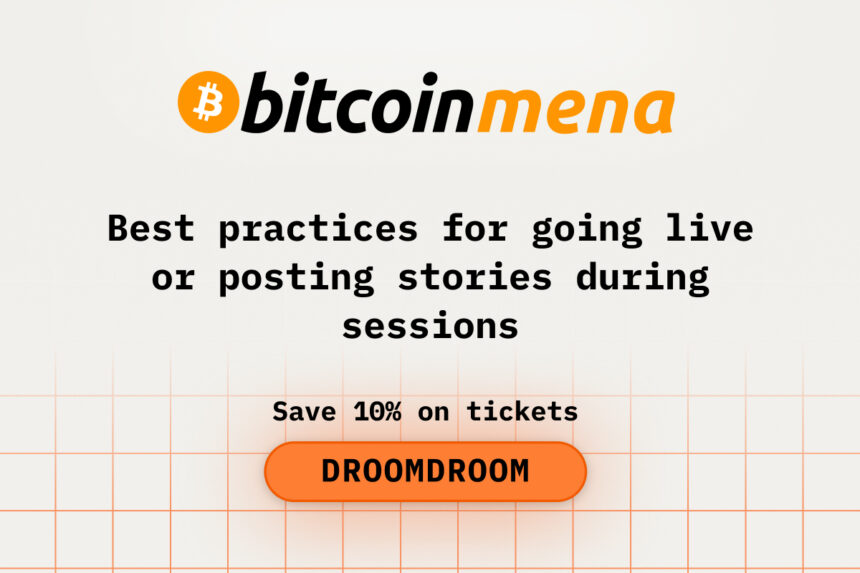
Use DROOMDROOM, the official Bitcoin MENA promo code, and save 10% on your ticket today.
During Sessions: What to Share — and How
Focus on Quality, Not Quantity
Rather than trying to post every few minutes, prioritize meaningful content. For example, record a snippet of a keynote, capture a key slide, or write down a memorable quote. A single well-framed photo or concise summary often resonates more than a barrage of posts. Experts in live-tweeting recommend summarizing key points concisely, rather than attempting a full transcript.
If you do quote a speaker, always use “quotation marks” and attribute the speaker or panel clearly. If the speaker has a known handle on social media, add it — it’s both professional courtesy and helps others follow their work.
Use Official Hashtags and Contextual Tags
Every conference typically has an official hashtag — use it. This links your posts into the broader conversation, helping attendees and remote followers find and engage with your coverage. Short, clear hashtags usually perform best.
If the session is part of a larger track or sub-theme (for example, “DeFi & Regulation” or “Bitcoin Developers”), include that context — it helps users quickly understand what the post is about.
Include Visuals — When Permitted
Visual content — slides, candid photos, venue snapshots — adds authenticity and richness. A slide with interesting data, a crowd shot, or a selfie with fellow attendees can make stories more engaging. Many social-media guides emphasize that images/videos dramatically increase engagement.
But be mindful: only share images when it’s allowed. Avoid wide-angle crowd shots unless you have permission from organizers.
After the Session: Amplify and Reflect
Share Reflections or Key Takeaways
Once the session wraps up, consider posting a short recap — reflect on what stood out, what inspired you, and what people should remember. This adds value beyond mere live coverage and helps consolidate your thoughts for viewers.
Pooling live posts into a highlight reel or thread can help new followers catch up quickly. Many conference-tweeters compile live content into a structured thread so that the narrative remains coherent and easier to follow.
Engage with the Community
If attendees or viewers comment or reply to your live posts — engage. Answer questions, share extra resources, link to relevant slides or speaker bios. Engaging builds relationships and can lead to meaningful conversations beyond the session.
Also, don’t hesitate to retweet or share other attendees’ posts — especially if they captured something you missed. Collaborative coverage enriches the event’s collective memory and strengthens connections.
Common Pitfalls & How to Avoid Them
One frequent mistake is over-posting — dumping multiple posts per minute or flooding stories without context. This can overwhelm your audience and even annoy followers.
Another pitfall is mis-attribution or mis-quoting. Posting inaccurate quotes can damage your credibility. Always double-check before sharing.
Ignoring privacy or event etiquette — such as filming restricted sessions or audience faces without consent — can lead to conflict or damage relationships. Respect for organizers, speakers, and attendees should guide your posting decisions.
Finally, poor technical quality — shaky video, blurry images, bad lighting — can reflect poorly on your coverage. A well-composed photo with good lighting often beats a high-volume of low-quality posts.
Conclusion
Live-posting or sharing stories during sessions at Bitcoin MENA can be much more than a casual social-media exercise. When done thoughtfully, it becomes a powerful tool for community building, real-time commentary, and personal brand growth.
By preparing ahead, respecting rules and speakers, prioritizing quality over quantity, and engaging thoughtfully with your audience — you can turn your attendance into a dynamic content stream that resonates long after the conference ends.